There is no universal workshop for impact communication
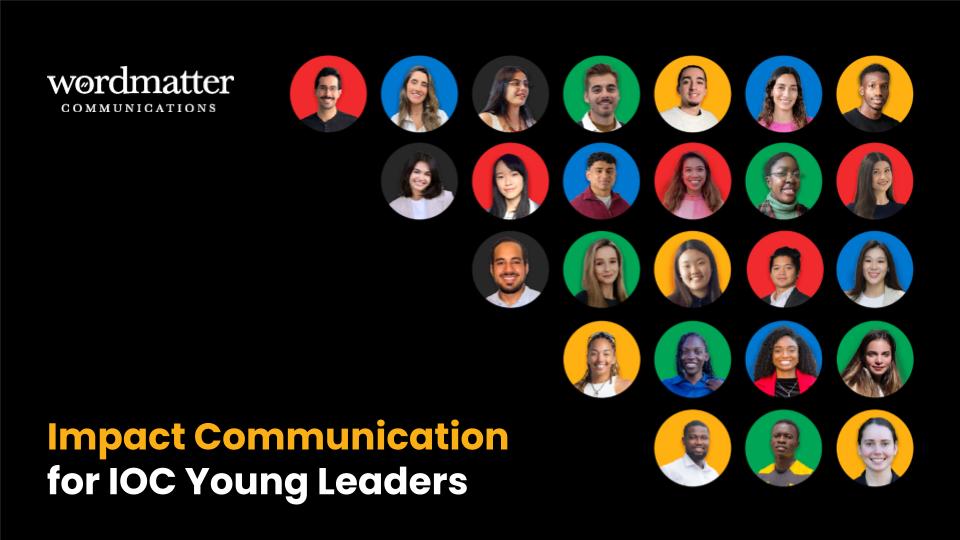
When the International Olympic Committee (IOC) asked Wordmatter Communications to design and deliver impact communication workshops for their Young Leaders Programme cohort, the brief was simple enough. Help these leaders use the data from their projects to talk about their work, and move from the activity-driven messaging of ‘I am a young leader and I do this’ to talking about their projects in a way that attracts the right partners, funders, and collaborators. What followed was anything but simple, and we mean that in the best possible way.
The cohort spans continents. On the call were leaders from across Africa, the Americas, Asia and the Pacific, the Middle East, and Europe. Some were pursuing PhDs in life sciences. One had a background in journalism. Their projects ranged from mental health support for student-athletes to environmental stewardship through sport, anti-bullying programmes in schools, and platforms connecting people with disabilities to volunteering opportunities at major sporting events. And every single one of them was doing this alongside a full-time job or degree.
How do you design for a room like that, in a way that it lands? Here are 5 ways in which we approached it, and what we would do again.
1. Get into their shoes first. Really.
The most common mistake in capacity building workshops is designing from the content outward. You have a topic, you have slides, you deliver. But knowledge that doesn’t translate to practice tends to evaporate the moment the call ends.
Our first design question was not 'What do we need to cover?' It was: what does Young Leaders' Day actually look like? Most of these leaders are running sports-for-development projects in hyperlocal communities, on top of full-time jobs or studies. They are managing volunteer WhatsApp groups, writing grant updates late at night, and preparing for field sessions on weekends. Time is the thing they have least of.
Which is why we made a deliberate call early on.
This workshop could not add to the cognitive load. It had to reduce the load. That meant frameworks easy enough to remember on a busy Tuesday, examples vivid enough to stick, and structures that work whether you have twenty minutes or two hours to write.
It also meant we could not assume any baseline. Someone with a master’s in journalism and someone finishing a PhD in life sciences will approach the idea of ‘data’ very differently. It would have been a mistake to assume they must know so much about communication already. Most people communicate all the time, yet it is rare that someone engages the same way when communication has a purpose and a project behind it. That distinction between casual communicating and intentional impact communication became the first thing we named, out loud, in Session 1.
2. Evoke the thinking. Don’t hand over the formula.
Ready-made formulas work a couple of times and then they stop working, because they only cover the contexts they were designed for. What these leaders needed was not a solution. They needed a way of thinking that would hold regardless of whether they were writing a LinkedIn caption, a funding proposal, or a WhatsApp message to a community partner six months from now.
Session 1 started with a single sentence on the screen. “I ran a training session for 25 girls.” We asked the group what this sentence tells us, in the context of impact communication.
The room landed on the same answer. It describes activity. It tells us something happened. But it doesn’t tell us what changed.
And that became the pivot point of Session 1: the shift from describing activity to demonstrating change. Ambassadors, donors, and partners don’t fund sessions. They fund change. The difference between the two is evidence, framed right.
We ran the same approach in Session 2 when tackling platform choices and digital presence.
Rather than telling leaders where to post, we gave them a self-research framework, a set of questions to interrogate their own context.
Who needs to know this exists, and where do they already gather? What does credibility look like to my funder, and where do they look for it? What story about this project should live permanently online? These questions are not just useful today. They will guide platform decisions as the projects grow and shift through phases.
3. Frameworks that hold on busy days, and flex on creative ones
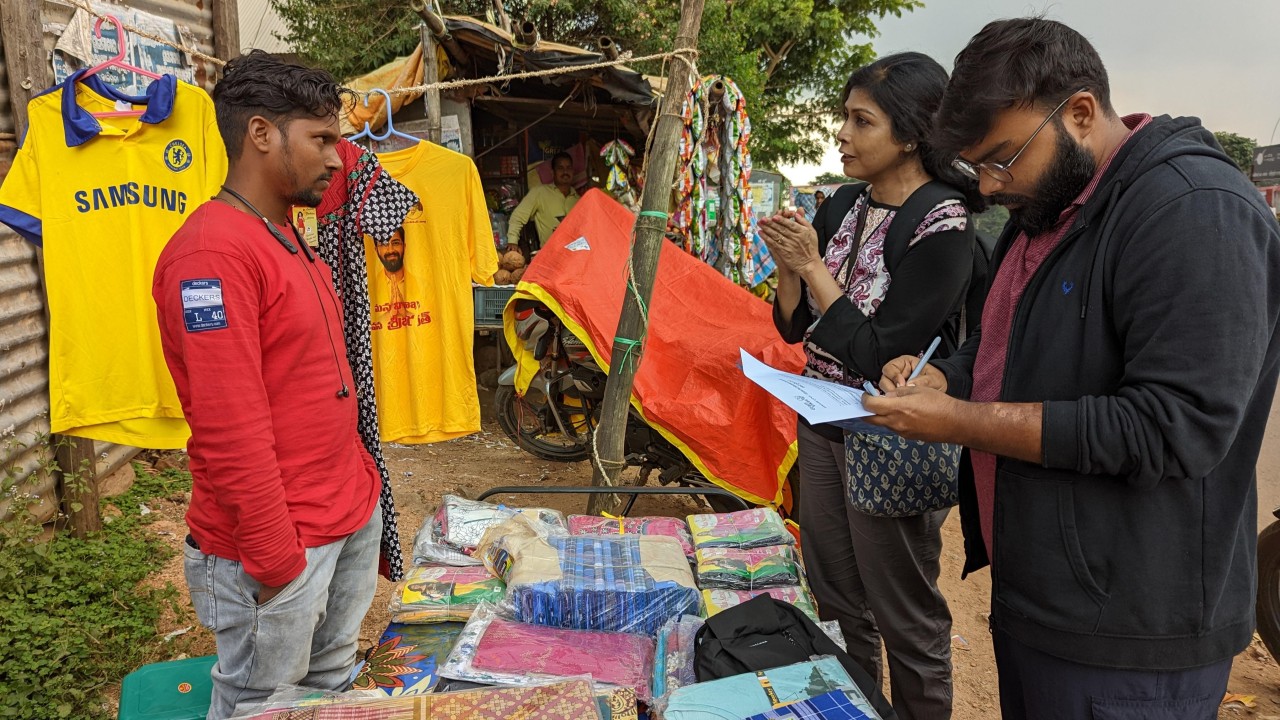
The diversity of the cohort shaped how we approached session content. A journalism graduate and a life sciences PhD come to the word ‘data’ from very different places. Some in the room were comfortable with complex datasets; others had never thought of a conversation overheard at a community event as evidence of anything.
For storytelling in social development, though, the most powerful and time-tested approach is the blend of numbers, trends, and anecdotes. Numbers give weight and anecdotes, meaning. Together, they humanise the data.
The tool we brought in was designed to work for everyone in that room. A mental recognition and recall tool called the Head-Heart-Eye. What made it work across the range was that it didn’t ask people to change how they already collected information. Whether you were drawing from everyday observations, a quick secondary search, or a detailed survey, it gave you a structure to see what you already had. For the beginner, it makes the everyday legible: a parent staying back after sunset to watch their child’s football session, a YouTube comment under a video, a conversation overheard in a cafeteria. For the practitioner already running surveys, it organises what they know into a story-ready shape. This framework was a data collection tool and a writing scaffold, in one.
Session 2 introduced a repeatable writing framework, flexible enough to help write a caption, a carousel post, a 30-second video, or a long-form article. We wanted them to hold it with both a narrow frame and a broad one. Narrow for short-form social platform messaging, broad for everything that comes after, including proposal pitches, long-form writing, and any format where the story needs to do sustained work.
The value of such repeatable, easy-to-remember systems unfolds on pressured Tuesdays when something needs to go out urgently. You reach for the structure without thinking and it holds. On a day when you have more room, that same structure becomes a playing field, something to push against, experiment within, and develop more creatively.
Use it enough times and it stops feeling like a system. It just becomes how you think.
4. Local channels are digital channels, and most leaders were already there
Digital storytelling does not start and end on the big tech platforms. And designing a workshop as though it does is a mistake.
Most of these leaders had already built strong communities around their projects — through WhatsApp broadcasts, local outreach, handouts at community centres, and word of mouth. They were already communicating. The question was how to do it with more strategic intent.
When we covered digital presence in Session 2, we were deliberate about including local channels as platforms in their own right. In many of the geographies where these projects operate, these are the channels where communities make decisions, build trust, and act on information.
To have skipped them in favour of Instagram strategy would have been to design for the wrong audience.
There is another dimension to this that we think often gets missed. The credibility of a channel varies by geography and context. A WhatsApp endorsement from a respected community figure builds trust in one setting. A LinkedIn post does it in another. We included this as part of the self-research method in the digital presence section. Leaders need to ask not just where their audience is, but what credibility looks like to that audience and where they look for it.
5. Questions are the richest part of the workshop. Design for them.
We always build in time for questions, not as a courtesy at the end, but as a deliberate part of the design. A single question from the group can extend the scope of a session in ways that no additional slide can replicate. That said, we will be honest: in Session 1, we would have liked to hold more space for questions than we did. Session 2, we corrected that.
The learning we would share with anyone designing something similar is this.
The more tailored and specific your content, the more questions it will generate. Quality invites interrogation. So plan for it generously, not as an afterthought.
Questions are interpretations. They tell you, in real time, exactly where a concept hit a wall in someone’s mind, and that wall is almost always shared by others in the room who did not raise their hand. When you answer a question in front of a group of twenty-five, you are very often answering it for most of them. They are also course corrections. If a question reveals that something landed differently from how we intended, that is not a problem. It is information. It shapes the rest of the session and it shapes the next one.
We have come to trust something else alongside questions: the pause — not a prompt or a cue to fill the silence, just the pause itself, held without apology. Psychology has a lot to say about the pregnant pause, and in practice, it is one of the most underused tools in facilitation. We have come to trust that almost every time, the room will fill that pause. And what comes out of it is usually better than anything you could have prompted.
Some of the richest moments from these two sessions came from questions we had not planned for. The discussions and questions from Session 1 surfaced contexts and insights which fed directly into what we built for Session 2. Questions are, in that sense, live feedback on how well you have understood your audience.
What we would say to anyone designing something similar
The biggest risk in a workshop like this is designing for an imagined audience. The temptation is to assume people are already communicating well and just need some polish. The reality is more layered, and far more interesting.
In this case, Young Leaders were doing significant work in resource-constrained, hyperlocal contexts. They communicated constantly. What they needed was the habit of doing it with critical intent. Not just ‘what should I post’ but ‘who is this for, what proof would move them, and what exactly do I want them to do?’
How we designed this for IOC Young Leaders, given their age group, their time constraints, their diversity of backgrounds, and their projects that straddle health and environment and philosophy and access, would be very different from how we would design it for another audience. That is key.
There is no universal workshop for impact communication, just as there is no universal story.
The shift from reactive posting to intentional positioning is not a technique you can hand someone in a slide deck. It is a way of thinking. And if two sessions can plant that, give someone the frameworks, the questions, and the habit of disciplined noticing, then the stories they tell about their work will carry further, land with the right people, and do more for the communities they are building for.
That, ultimately, is what impact communication is for.
About The Session
Wordmatter Communications designed and conducted a two-session workshop on impact storytelling for IOC Young Leaders between February and March 2026. Session 1, titled ‘Data for Storytelling’, covered how to recognise and use evidence from everyday work, and how to move from describing activity to demonstrating change.
Session 2, titled ‘Creating Scroll-Stopping Stories and Building Digital Presence’, covered structuring stories for digital platforms and making intentional choices about where and how to publish. Between the two sessions was an inter-session challenge, which gave Young Leaders the opportunity to apply their learning by writing for a digital platform of their choice. Each submission received individual feedback.
Sukriti Ojha led this workshop with support from Apoorw Raj Pandey.
About the Author
Sukriti Ojha is a Development Communications Writer with Wordmatter Communications.

One more story worth telling